
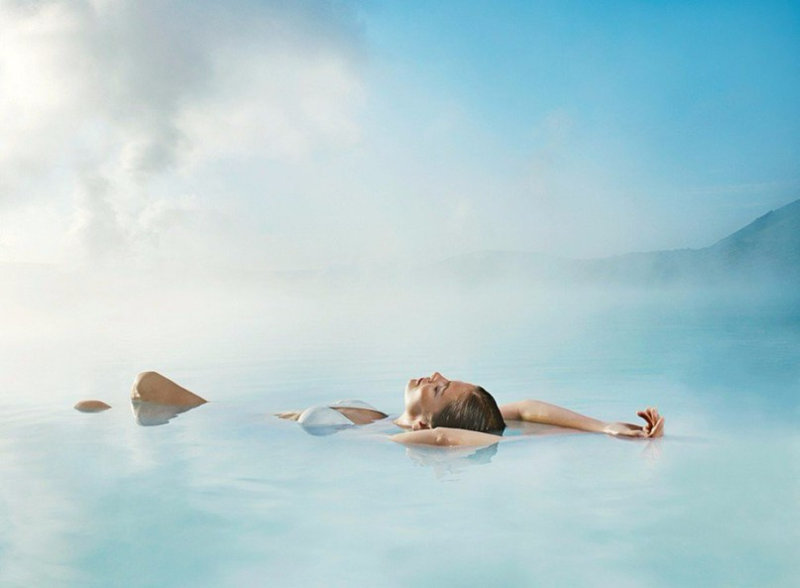
In the southwest of Iceland lies the Reykjanes Peninsula. Its peculiarity is that it is almost entirely formed by solidified lava. Solidified lava is a porous, loose material. That is why sea water easily seeps through it, filling natural reservoirs. And it is here, in Svartsengi (Svartsengi), very close to the surface of the earth magma strata, which creates a zone of high geothermal activity. In 1976, a geothermal power plant was built in Svartsengi.
The wells of this power plant are several hundred meters deep and reach reservoirs of geothermal water with temperatures of about +240 °C. It is these conditions that have contributed to the emergence of the Blue Lagoon, a unique natural open-air pool created partly by nature and partly by human activity. The temperature of water in the Blue Lagoon all year round is about +37 ° C, and its composition is a mixture of fresh (35%) and sea (65%) water, saturated with silicon. In general, geothermal water is unique in its composition – it contains sea salt, white clay, quartz, silicon, even blue-green algae. The hydrogen index is 7.5 and the salt and mineral content is 2.5%.
The water of the Blue Lagoon has healing properties. It is proved that despite the ideal conditions for the reproduction of microorganisms in this water, in the Blue Lagoon bacteria do not take root. At a water temperature of 37 ° C, the concentration of silicon in the water increases, and forms a white silicon porridge, which fills the cracks in the lava and makes the bottom of the Blue Lagoon waterproof. The reservoir is constantly expanding, now its size reaches 200 meters wide, several kilometers long, depth – about 1.5 meters, in some places reaches up to 3 meters.
To enjoy an exotic bathing in an open-air geothermal pool, more than 300,000 people come to Iceland every year. Warm milky-blue water, northern lights overhead, healing properties of silica clay, unforgettable impressions, uniqueness of the Blue Lagoon itself – all this attracts more and more people.