
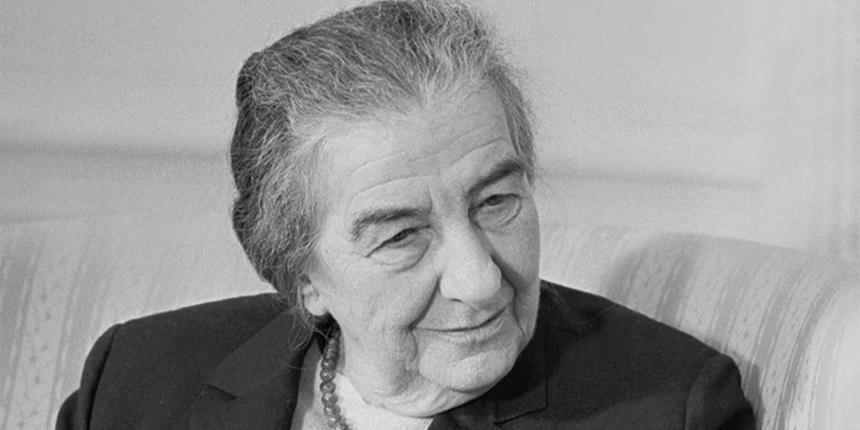
Born in Kyiv on May 3, 1898, Golda Meir emerged as one of the most influential female political figures of the 20th century, a destiny unbeknownst to her parents, Moshe and Blume Mabovitch, who raised her as one of their eight children. From her formative years in the Russian Empire to her transformative forays into politics, here are six compelling facts about Golda Meir.
Golda Meir’s Most Notable Achievements
Golda Meir made her mark as a distinguished politician, playing a pivotal role in the establishment of the state of Israel in 1948. Her political journey reached its zenith when she assumed the role of Israel’s fourth Prime Minister, serving from 1969 to 1974. Notably, she was the first female head of government in Israeli history and remains the sole female head of government in the Middle East to date.
During her tenure as Prime Minister, Golda Meir adeptly navigated the tumultuous waters of the Yom Kippur War. This conflict, also known as the Ramadan War and the October War, unfolded from October 6 to October 25, 1973, pitting Israel against a coalition of Arab states. Her leadership during this crisis is a testament to her enduring legacy in Israeli history.
Golda Meir’s Origins and Early Life
Golda Meir’s roots trace back to downtown Kyiv, a city that, in her birth year of 1898, was still within the boundaries of the Russian Empire. However, as history unfolded, Kyiv is now situated in modern-day Ukraine. The Meir family’s journey led them across continents. Golda’s father embarked on a quest to America in search of work, eventually paving the way for his family to join him by relocating to Milwaukee.
During her teenage years, Golda found herself in conflict with her parents’ wishes for an early marriage and a settled family life. Her aspirations diverged from these expectations, leading her to make a bold choice. She decided to run away and seek refuge with her married older sister, Sheyna, to pursue higher education.
In 1913, while residing with her sister in Denver, Colorado, Golda Meir engaged with intellectual discussions on progressive topics such as women’s suffrage, Zionism, and trade unionism. These conversations left an indelible mark on her, helping to shape her unwavering and passionate convictions that would guide her later in life.
Golda Meir’s Personal Life and Political Career
Golda Meir’s journey through life took an unexpected turn when she met her future husband, Morris, while residing with her sister. Their love story began in the vibrant atmosphere of her sister’s home, where gatherings of Zionists kindled their affection.
Upon their return to Milwaukee, Golda embarked on a career path to become a teacher. However, her dream of teaching in a school was never realized. In 1921, a significant chapter in their lives unfolded as Golda and Morris set their course for the Land of Israel. It was in this new land that Golda Meir’s political career would take flight.
Golda’s legacy extends beyond her political career; she played a pivotal role in the establishment of the State of Israel. Her dedication to this endeavor went further as she assumed the role of Israel’s Minister of Labour between 1949 and 1951. During this time, she oversaw a remarkable influx of Jewish refugees from various corners of the globe, causing the population to double from 800,000 to 1,600,000.
The Yom Kippur War, also known as the Ramadan War or the October War, was a defining moment during Golda Meir’s leadership. As the first and only female Prime Minister of Israel, she navigated the nation through the complex challenges of this conflict. Although her leadership during the war drew mixed reactions, with many critics attributing blame for the outbreak of hostilities to her, Golda ultimately resigned as Prime Minister in April 1974 due to political disputes within her government.
Despite her departure from the seat of power in June 1974, Golda remained engaged in the realm of politics. Her life took a poignant turn when she succumbed to Lymphoma, passing away in 1978. Golda Meir’s contributions and influence have left an enduring mark on the history of Israel and the world.
Five Golda Meir quotes
● ‘Not being beautiful was the true blessing. Not being beautiful forced me to develop my inner resources. The pretty girl has a handicap to overcome.’
● ‘I can honestly say that I was never affected by the question of the success of an undertaking. If I felt it was the right thing to do, I was for it regardless of the possible outcome.’
● ‘Don’t be so humble – you are not that great.’
● ‘Trust yourself. Create the kind of self that you will be happy to live with all your life.’
● ‘One cannot and must not try to erase the past merely because it does not fit the present.’