
The Origins of Conflict
Around 1573, Japanese traders began exchanging gold for silver on the Philippine island of Luzon, particularly in regions such as Cagayan, Metro Manila, and Pangasinan. However, in 1580, a band of pirates forced the natives of Cagayan into submission. These marauders, known as Wokou, had previously been confronted by the Chinese Jiajing Emperor.
In response to the piracy menace, Gonzalo Ronquillo, the Governor-General of the Philippines, tasked Juan Pablo de Carrión with addressing this issue. Carrión took swift action by shelling a Wokou ship, possibly of Chinese origin, in the South China Sea.
Opposing Forces
The Wokou fleet consisted of one junk and 18 sampans, small flat-bottomed fishing boats. Although the group comprised Japanese, Chinese, and Philippine raiders, the leader’s name, Tay Fusa, suggests Japanese leadership. Interestingly, the name may be a transliteration of “Taifu-sama,” with “taifu” meaning a Japanese medieval chieftain. The pirates were armed not only with bladed weapons but also with muskets supplied by the Portuguese.
In contrast, Carrión gathered a force of forty soldiers and seven boats, including a galleon named “La Capitana.” While outnumbered, the Spanish had several advantages, including their experience with firearms, superior armor, and weaponry.
The Battle Unfolds
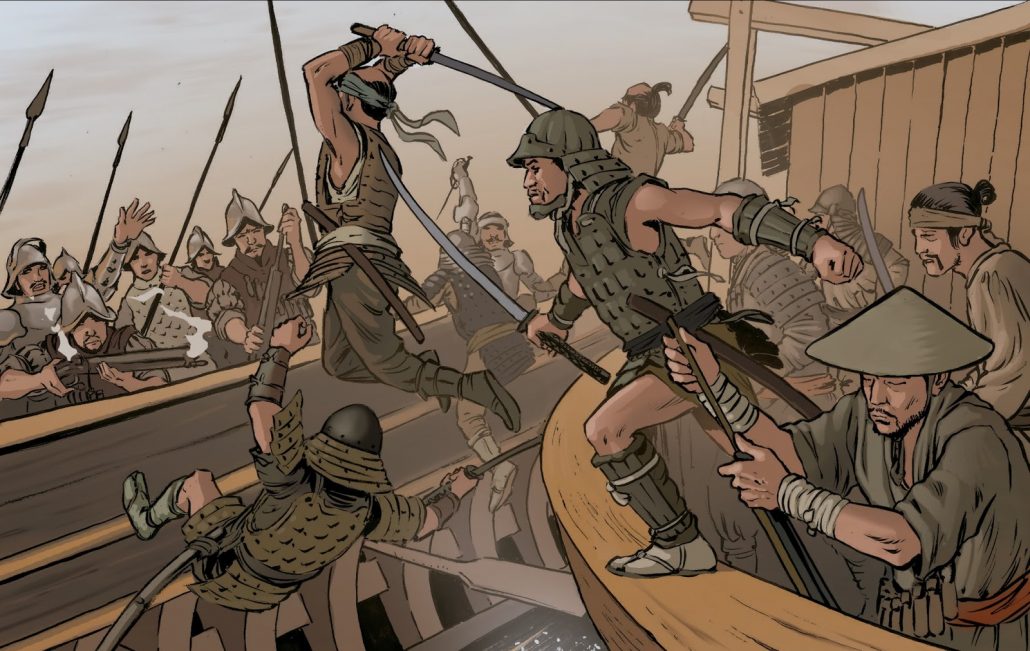
As the Spanish flotilla approached Cape Bojeador, they encountered a heavily armed Wokou sampan. This encounter led to a naval battle, with Carrión’s men eventually boarding the sampan. Here, the Spanish soldiers faced armored Japanese Wokou wielding swords, leading to intense close combat. After initial setbacks, the Spanish regained the upper hand, thanks to well-timed reinforcements.
Continuing down the Cagayan River, the Spanish found a fleet of eighteen sampans and a Wokou fort onshore. The Spanish deployed artillery and disembarked to establish a beachhead. They bombarded the pirates from their positions while enduring pirate counterattacks.
Negotiations followed, but when the Wokou demanded gold in return for leaving Luzon, Carrión refused. The Wokou then launched a land assault with approximately six hundred fighters. The Spanish, defending their trenches, endured several assaults. As their gunpowder supplies dwindled, they engaged in close-quarters combat, eventually routing the remaining Wokou.
The aftermath of the battle saw the region pacified, and Carrión went on to found the city of Nueva Segovia, now known as Lal-lo. While pirate activity diminished after the battle, the local Spanish viceroy requested additional troops due to the fierce nature of the conflict.
In conclusion, the Battle of Cagayan was a significant event in Philippine history where Spanish forces, led by Captain Juan Pablo de Carrión, triumphed over pirates, possibly including Japanese Wokou. While it marked a victory for the Spanish, the battle involved complex dynamics and tactics that led to its ultimate outcome.