
A Journey through Time
In “SEX: A Bonkers History,” we embark on a captivating exploration of how human sexuality has influenced and shaped civilizations across the ages in ways that continue to surprise us. Hosted by Amanda Holden, the show delves into some of history’s most obscure and risqué stories about sex. The premiere is scheduled for Monday, September 18th, at 9 pm on Sky HISTORY.
From Ancient Times
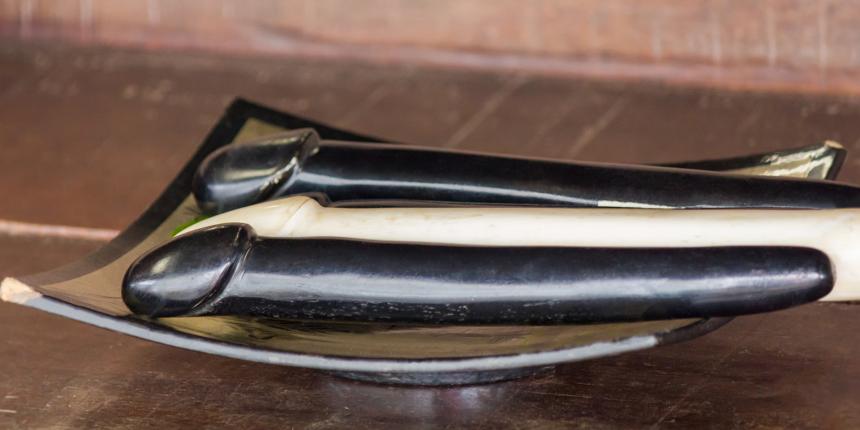
Sexual aids have left their mark throughout history, from pagan societies that revered female orgasms as ritual offerings to the discovery of a double-ended device for female lovers amidst the ruins of Pompeii. However, many of our modern bedroom classics have their origins in the annals of history.
Inception
Back in 1992, archaeologists unearthed a mysterious 2000-year-old wooden “object” in the Roman Fort of Vindolanda, Northumberland, initially categorizing it as a darning tool. However, a more open-minded examination led to its reclassification as a sexual aid due to its size, shape, and intricate details.
But this is far from the earliest known discovery. Dating back to around 500 BC, ancient toys carved from stone, leather, wood, and even camel dung and resin have been found. Yet, the title of the oldest known sexual aid belongs to a 7.8-inch siltstone phallus discovered in Germany’s Hohle Fels cave in 2005, dating back approximately 28,000 years and predating the advent of agriculture by 13,000 years.
What’s in a Name?
While rubber dildos made their debut in 1850, the term “dildo” is older than you might think, originating around 1400 AD. It derives from the Latin word “dilatre,” meaning “open wide,” and the Italian “diletto” or “delight.”
In Ancient Greece, these objects were known as “olisbos,” designed to provide comfort to women while their husbands were away. There was even a jesting suggestion of an “olisbokollix” made from bread for a softer experience.
A Matter of Medicine
Babylonians had a unique approach to sexual health, using warm bread for men suffering from external urethral obstructions to induce ejaculation, long before the concept of “pie” was associated with such matters.
In the United States, Frank E. Young’s 1892 “Rectal Dilator” was a popular cure for piles until the 1938 Federal Food, Drugs, and Cosmetics Act intervened due to false advertising.
In Victorian London, women diagnosed with “female hysteria” were treated with “pelvic massages” to induce a “hysterical paroxysm” (distinct from orgasms to maintain respectability) as the idea of female arousal was taboo.
Enter Vibrators
By the mid-19th century, about 75% of Victorian London’s women had received treatments for hysteria, leading to the search for more efficient solutions. The 18th-century “Tremoussir” was the first vibrator, a portable wind-up device, albeit underpowered and prone to running out of steam prematurely.
In America, George Taylor’s steam-powered “Manipulator” emerged in 1869, but London’s Dr. Joseph Granville developed the first electromechanical vibrator in 1880, predating electric irons and vacuum cleaners by a decade.
By 1909, vibrators had a market presence, with articles appearing in publications like Good Housekeeping. However, they were not considered sexual, as sexual activity was narrowly defined as penetration. Vibrators were openly displayed until the late 1920s when their appearance in early adult films changed societal perceptions.
Toys for Everyone
It’s not just women who explored solo adventures. In the 17th century, French sailors took their “Dame de Voyage” to sea, a precursor to the vulcanized rubber inflatable girlfriends of 1904, made from rags. These innovations contrasted with Parisian catalogs in 1908 offering “custom dolls resembling any actual person, living or dead.”
In China during the 3rd century, male nobility used rings made from goat eyelids with eyelashes to enhance their sexual prowess. Simultaneously, India’s Kama Sutra depicted the use of Apadravyas, fastened with a strap and featuring an impressive extension of gold, ivory, or silver, for similar purposes.